
How to Manage Your Money with a Cash Flow View
How to manage your money starts before any app or spreadsheet: with a plan for how you want your life to work, and a cash flow view that shows whether you are sticking to it. A four-bucket framework you can argue with.
How to Manage Your Money with a Cash Flow View
General Advice not Specific to Your Situation
We are not financial advisers. You should consider seeking independent legal, financial, taxation or other advice to check how the website information relates to your unique circumstances. We are not liable for any loss caused, whether due to negligence or otherwise arising from the use of, or reliance on, the information provided directly or indirectly, by use of this website.
How Do You Actually Manage Your Money?
Ask someone why they're trying to save money, and watch what happens. There's a pause. Then something vague surfaces: to be safe, for the future, just in case. Push a little further, ask what safe actually looks like, or what the future is even for, and the answers get vaguer still.
That's not a failure of intelligence. It's a failure of design. Nobody ever handed these people a blueprint for the question, so nobody built one. "Save more money" isn't a plan. It's a mood, a number sitting in an account, growing, in service of absolutely nothing in particular.
Before any budgeting advice matters, before any app or spreadsheet, you need something more basic, and it is the part almost every guide to how to manage your money skips: a plan for how you actually want your life to work. What follows is one attempt at building that plan, a framework, not the framework. It works for its author. It might not work for you, and that's fine, the point isn't to adopt this one wholesale. Read it, argue with it, keep the parts that fit and throw out the rest, or build your own from scratch. What you can't really afford to do is have nothing at all.
How Should You Consider Income?
Here's a question almost nobody asks about their own side hustle: is it actually making you money? Freelance work, an investment property, even a hobby that brings in a little cash, most people can tell you what it brings in. Almost nobody can tell you, with any confidence, what it costs them to earn it.
The fix is almost embarrassingly simple: when you're setting up your cash flow table, give each income source its own category, with a subcategory for the income itself and further subcategories for whatever it costs you to earn it. A regular 9-to-5 job comes with commuting costs, tax return fees, work clothes, tools or gear, maybe a job-related subscription or two. A side income stream deserves the exact same treatment: its own lane, its own costs, tracked separately from everything else.
Do that, and the question answers itself. You can see, plainly, whether each source is actually making you money or quietly costing you more than it's worth.
What Is a Useful Way to Consider Expenses?
So what does an actual framework look like? Here's one candidate. Every pound you spend, when you look closely enough, falls into one of four buckets. Naming which bucket a purchase belongs to does most of the work of deciding how much you should actually spend on it, before you've even opened your wallet.
This isn't the only way to carve up a financial life, and it isn't offered as one. If you come up with something better, let me know and I'll publish it. Treat what follows as a reaction starter: adapt it, argue with it, or throw it out and build your own. Just land on something.
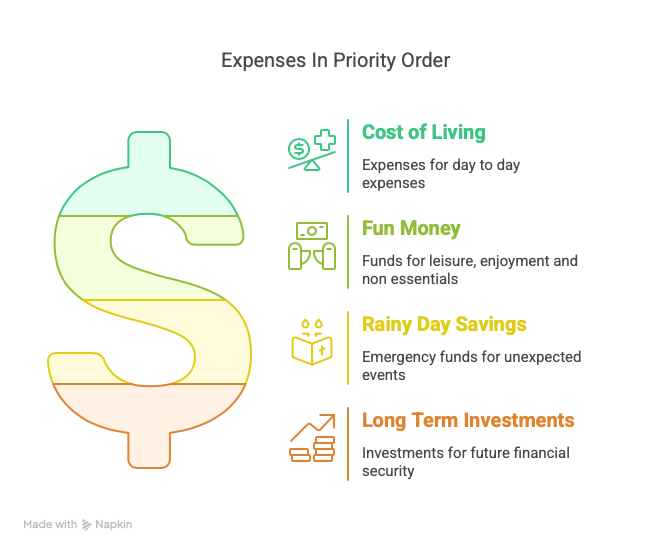
Cost of Living

Here's the least glamorous question in personal finance, and also one of the most important: what's the absolute minimum required to keep your life running? Housing, utilities, food, transport, healthcare, the interest on loan repayments, all of it lands here.
This is the one bucket where the goal isn't optimising for enjoyment, it's reduction. Every pound that leaves this bucket is a pound that was never available to do anything more interesting with. Track it accurately, not because tracking is virtuous in itself, but because you can't shrink what you can't see.
Your aim here should simply be to make this bucket as small as comfortably possible.
Fun Money

Now the more interesting question: given that life is supposed to be enjoyed and not endured, how much of it are you actually willing to pay for, on purpose? Fun money is the portion of your income set aside for the things that bring you joy, dining out, hobbies, holidays, whatever counts for you. It exists specifically so you don't have to feel guilty about spending it, guilt was never the point.
What is the point is deciding on purpose. It's remarkably easy to fritter this bucket away in small, forgettable increments, an extra coffee here, another round there, until it's gone and you can't point to a single thing it bought you. The more interesting version of this bucket is deliberate: maybe the daily coffee matters less to you than upgrading the car, or a proper holiday. You can't do everything. That's exactly why the choice is worth making consciously instead of by accident.
Your aim here should be to set a real limit and actually stick to it. You will find no shortage of reasons to blow through it.
Rainy Day Savings

Here's a question with an oddly certain answer buried inside an uncertain one: do you know what your next financial emergency will be? No. Do you know that you'll have one eventually? Also no, not really, but close enough to plan around. Something unexpected, medical, mechanical, employment-related, is close to guaranteed over a long enough timeline. You just don't get to pick which one, or when.
Financial experts generally land on three to six months of living expenses, held somewhere genuinely accessible, as the answer to that uncertainty. This bucket isn't about return, it's about resilience, the ability to absorb a bad surprise without it turning into a debt spiral.
Cash is the cleanest form of this, though a mix of cash and available credit works if your money is tied up elsewhere. Read this if you want to
optimise the amount of rainy day savings.
Long Term Investments

And here's the question that separates people who end up wealthy from people who've merely earned a lot: where does the money go once the first three buckets are covered?
An investment appreciates in value or generates an income. Retirement accounts, stocks, bonds, real estate, including the home you live in, all belong here. Invest early and consistently, and inflation plus compounding do most of the remaining work for you, quietly, in the background, exactly the way it's supposed to.
The unglamorous advice, and the only advice that actually holds up, is to stick to mainstream, broad investments (think S&P 500, not someone's hot tip). Plenty of people have lost a great deal of money listening to confident strangers with exciting ideas. Unless you're counting on someone else to rescue your retirement for you, put enough here to actually fund it, because the government's version of generous may not match yours by the time you get there.
If you're earning extraordinary money for a short window, professional sport being the obvious example, this is the bucket to fill first, before anything resembling the big "I am....." Once retirement is genuinely funded, what you do with the rest is entirely your own business.
Why Does the Type of Expense Matter?
Here's where the framework stops being theoretical and starts being useful: almost no purchase is really about the thing you're buying. It's about which bucket it comes out of, and what that bucket not having that money means for your future opportunities.
Take a car. Say £30,000 buys something perfectly decent, and £45,000 buys the one you actually want. That's not really a £45,000 car question. It's a £30,000 cost-of-living decision plus a £15,000 fun-money decision, and the real question is whether that £15,000 is better spent on a nicer car than on, say, two genuinely good holidays. It's your money, your call, but it's a far more interesting call once you've named what it actually is.
Financing the car complicates it further, and productively so: are you willing to grow your cost-of-living bucket and your rainy-day bucket to match the new repayments? Would you rather build the rainy-day bucket first and buy the car after? Thinking it through this way means weighing the car's actual benefit to you and your family against its real cost to your finances, rather than listening to a salesperson who is, quite reasonably, paid to make you feel otherwise.
Here's the part that makes the whole framework worth the effort: none of this works as a mental exercise you do once and then forget. Your cash flow table's categories, the actual groups your transactions get sorted into, should map onto these same four buckets. Not as a separate system you translate between, but as the same system viewed two ways: the framework is the plan, the categorisation is the readout. When they line up, you're not asking "did I stick to my plan?" as a vague, once-a-year gut check, you're just looking at the numbers and the answer is already sitting there.
Succeeding at managing your money ultimately comes down to two unglamorous things: clear visibility of your cash flows, and the discipline to actually take the time to decide. No impulse purchases, every one you skip is just extra time you're handing the salesperson to work on someone else.
Which brings the whole thing back to the original question: why are you trying to save money? If cost of living, fun money, rainy day, and long-term investment isn't your answer, that's genuinely fine. But have one. And whichever buckets you land on, it's worth understanding why cash flow, not the value of what you own, is the number that actually determines whether any of it holds together: see The Importance of Cash.
Common Questions
How do you manage your money?
Start with the question this article opens on: what is the money actually for? Decide how you want your life to work, then sort every pound you spend into four buckets, cost of living, fun money, rainy day savings and long-term investments. Your cash flow table's categories should map onto those same four buckets, so the plan and the scoreboard become the same thing viewed two ways.
What is a cash flow view?
A running summary of money in and money out by category, month by month, built from your actual transactions. It is the readout that tells you whether you are living the plan you set, instead of a once-a-year guess.
How much should go toward each bucket?
There is no universal split, and this article does not offer one. Cost of living should be as small as you can comfortably make it; fun money needs a real limit you actually keep; rainy day savings is commonly three to six months of expenses; long-term investments get whatever is left, with retirement funded first. The point is to choose the numbers on purpose rather than by accident.
Further Reading
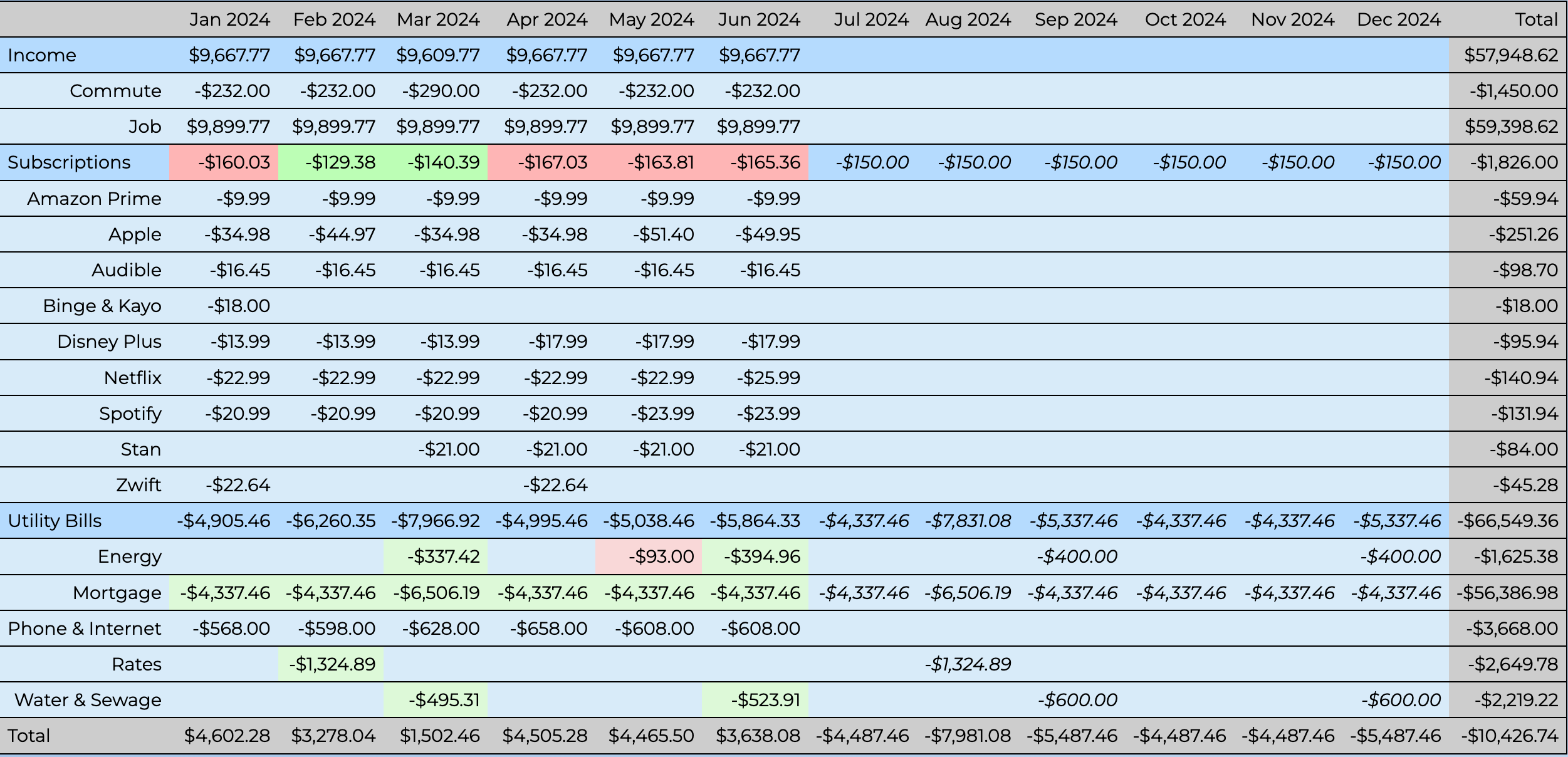 BlogBetter Money Management Using Cash Flow TablesWhat a cash flow table is, how to build one, and why it beats a cash flow spreadsheet for staying on top of your money.Read article
 SolutionBudgeting Without the Guilt TripUnderstand what you can and can't afford, and work within those limits without the guilt over every cup of coffee.Explore solution
 BlogCash Is King: Cash Flow vs Net WorthCash is king, but not for the reason the phrase usually implies. Why cash flow, not net worth, is what actually keeps you solvent.Read article
Disclaimer: We are not financial advisers. The information on this website is general in nature and does not take into account your individual circumstances. You should seek independent professional advice before making financial decisions.